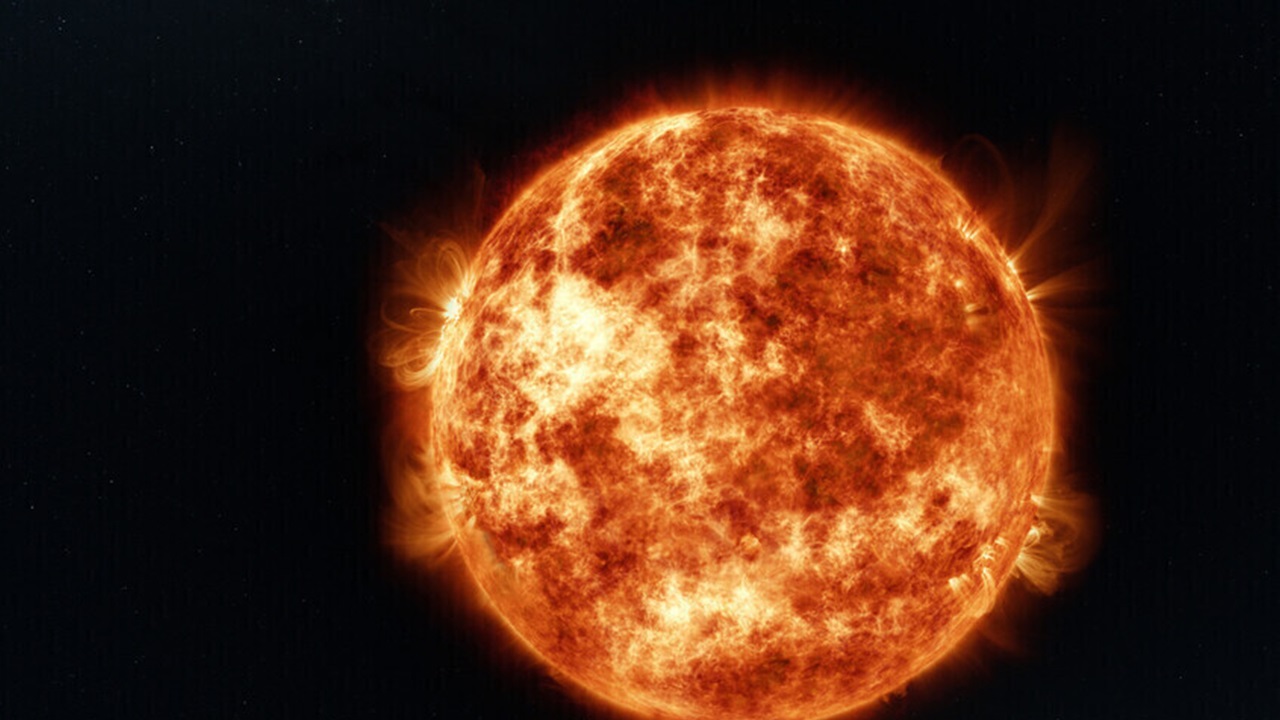
Solar ejection from December 2024 tracked by 17 spacecraft in record study
🎧 Listen to this article
A dedicated English MP3 is generated for this article.
0:000:00
Tap listen to prepare the audio.
Researchers recorded a coronal mass ejection that left the Sun on 15 December 2024 with 17 spacecraft operating from multiple vantage points, the largest such fleet used to observe a single solar eruption.
Earlier coordinated observations had relied on at most 10 spacecraft and were largely limited to the Sun–Earth line. The new campaign used platforms on different orbits and showed that the ejection advanced in two lobes in a clearly asymmetric pattern. The faster lobe moved at roughly 840 kilometers per second toward Earth and Mars, while a slower lobe traveling at about 534 kilometers per second traveled westward toward NASA's STEREO-A. Because the slower lobe initially masked the faster one, the SOHO spacecraft could only detect that component.
The event was first recorded by SOHO and then by BepiColombo near Mercury at 0.35 astronomical units from the Sun. When the disturbance reached Earth on 17 December 2024, it was logged by the ACE, DSCOVR, GOES, Wind, MMS and ARTEMIS missions. Solar Orbiter did not detect the event. The slower lobe arrived at STEREO-A on 18 December 2024, with Europa Clipper en route to Jupiter and MAVEN in Mars orbit also registering the eruption.
The researchers said the cause of the asymmetry remains unclear and that further work will examine whether such structures are more common than previously believed, possibly overlooked because of limited observation coverage.