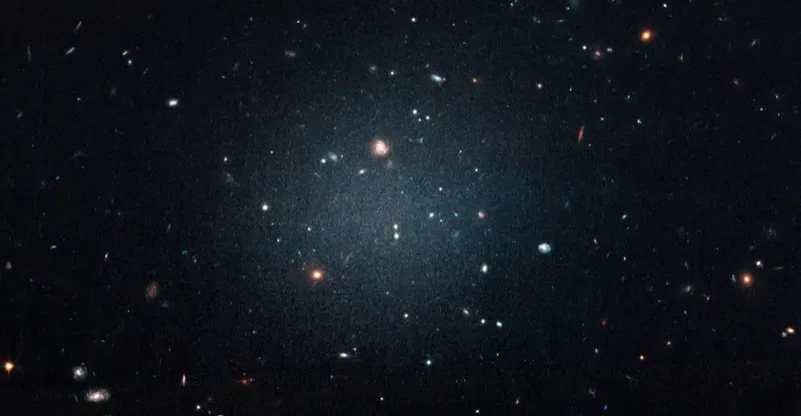
Astronomers report a third galaxy nearly devoid of dark matter
🎧 Listen to this article
A dedicated English MP3 is generated for this article.
0:000:00
Tap listen to prepare the audio.
A research team led by Yale University astrophysicist Michael Kim has identified a new galaxy, NGC 1052-DF9, located roughly 67 million light-years from Earth. Findings published on Science Alert indicate the galaxy contains almost no dark matter, a feature that challenges standard models of galaxy formation.
The prevailing view holds that galaxies form within massive dark matter halos, whose gravity keeps their stars bound together. DF9 shares this unusual trait with two earlier discoveries: NGC 1052-DF2, identified in 2018 by Pieter van Dokkum’s team, and NGC 1052-DF4, found the following year. The three galaxies line up in space and move in the same direction, which the researchers attribute to an "unusual and violent cosmic event."
Kim noted that while most galaxies in the universe are dominated by dark matter, DF2, DF4 and DF9 represent extremely rare exceptions. The team proposes that these galaxies formed after two dwarf galaxies collided: stars and dark matter passed through each other, while gas clouds slowed, condensed in one region and gave rise to new stars without dark matter.
The researchers said the findings provide some of the strongest evidence yet for the physical reality of dark matter.